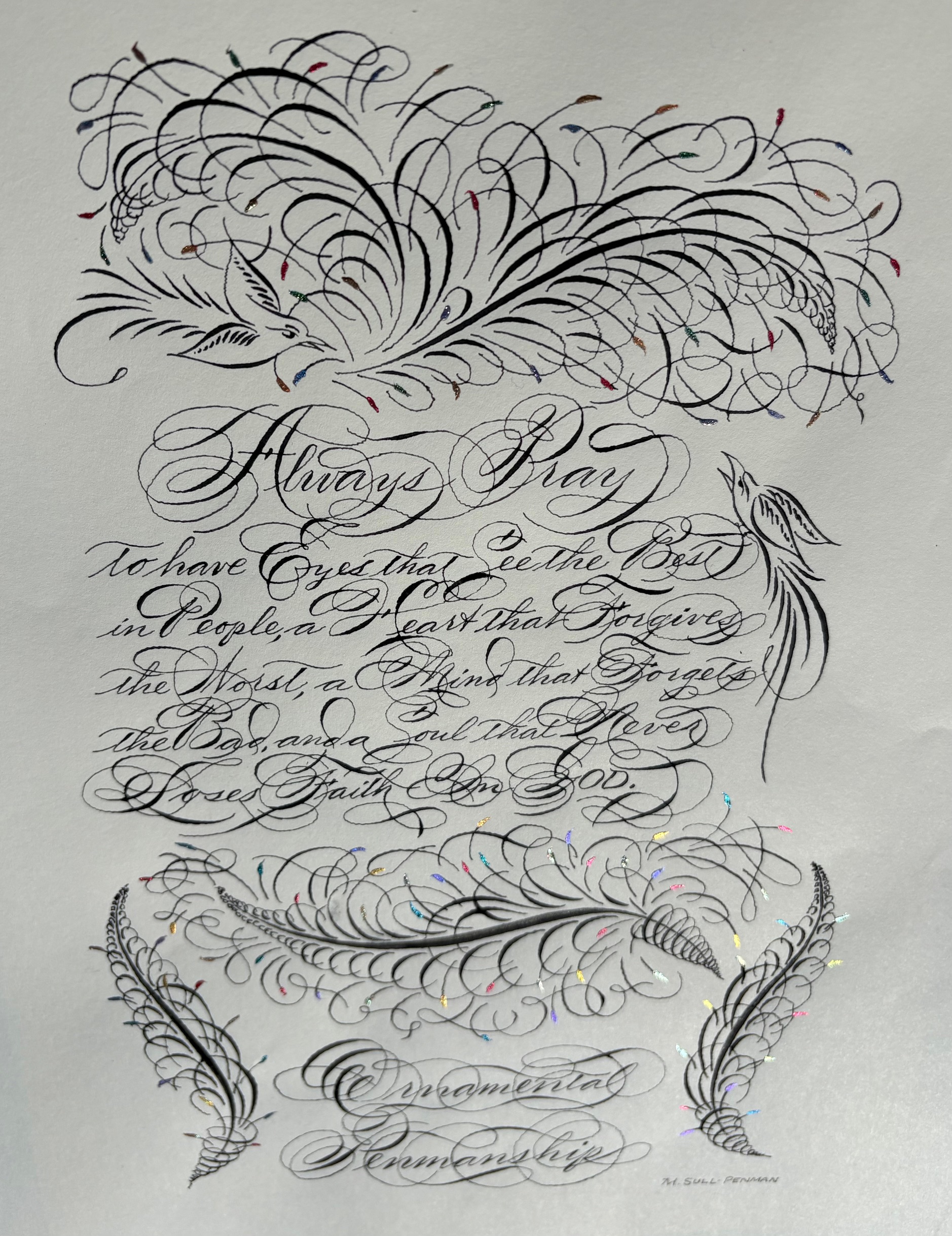
There are teachers who show you how to form a beautiful letter.
Then there are teachers who hand you an entire history.
When we sat down with master penman Michael Sull for Calligraphy Chronicles, we expected to hear stories about flourishing, Spencerian script, and a lifetime devoted to lettering. What emerged instead was something far richer: a living connection to the great American penmen of the nineteenth century and a reminder that every tradition survives because someone chooses to pass it on.
Michael is widely regarded as one of the world's foremost authorities on American penmanship, yet he speaks far more about his teachers than about himself.
That humility may be one of the reasons his influence stretches across generations.
Meeting a Legend
Every calligrapher seems to have a Michael Sull story.
When I mention his name, artists smile. Many tell me his books were their introduction to Spencerian script. Others speak about workshops that changed how they looked at lettering forever.
When I told Michael this, he simply smiled.
"I'm very proud of my students."
It was the perfect answer.
Instead of talking about his own accomplishments, he immediately began telling the story of the man who shaped his life: Paul O'Hara.
One Handshake from History
Paul O'Hara was born in the nineteenth century and graduated from the legendary Zanerian College in 1909. His own teacher had studied directly under Charles Paxton Zaner, one of the great masters of American penmanship.
When Michael met O'Hara in 1979, O'Hara was ninety years old.
Think about that for a moment.
One conversation connected Michael directly to a tradition stretching back to the golden age of American handwriting.
"I think I'm the last living penman trained by one of Zaner's personal students," Michael reflected.
For historians of calligraphy, that is remarkable.
For artists, it is priceless.
More Than Beautiful Letters
What struck Michael most wasn't O'Hara's technical ability.
It was the stories.
"He didn't just want me to make a perfect A or a perfect B," Michael explained. "He wanted me to know the story behind all of it."
Those stories transformed names from old books into real people.
The famous penmen whose signatures appeared beneath century-old specimens suddenly had personalities, friendships, nicknames, and adventures.
Earl Lupfer wasn't simply a master penman.
"He was 'Loopy,'" Michael laughed, recalling O'Hara's affectionate nickname for his former colleague.
In that instant, history stopped being something trapped inside books.
It became alive.
When Your Signature Was Your Reputation
Today, handwriting is often viewed as optional.
In the late nineteenth century, it was anything but.
Before typewriters became commonplace, your handwriting was often your first impression.
"It said everything about you," Michael explained.
A beautifully written signature suggested education, professionalism, discipline, and confidence.
Writing well wasn't merely decorative.
It was part of who you were.
That philosophy also gave birth to another cherished tradition.
The Gift of a Name
Michael has written thousands of decorative name cards throughout his career.
He never seems to tire of it.
The tradition reaches back to Spencer himself, who believed students should receive a beautifully written version of their own name.
It wasn't simply a keepsake.
It was something to aspire toward.
Every flourish, every graceful curve, every delicate hairline became a glimpse of what was possible through practice.
Today, Michael continues that tradition for students around the world.
In many ways, every name card is a quiet reminder that someone believes in your potential.
Chasing Knowledge
Michael's own journey into calligraphy began almost by accident.
After leaving the United States Navy, he simply wanted to improve his handwriting.
His mother had beautiful penmanship, and he hoped to develop something similar.
Finding resources wasn't easy.
There were almost no books for adults interested in handwriting.
Then one newspaper article changed everything.
A story in The Wall Street Journal introduced readers to Abraham Lincoln — not the president, but his ninth-generation descendant, who operated one of America's first mail-order calligraphy supply businesses.
Michael ordered books.
He practiced.
Eventually he started the Tidewater Calligraphy Guild in Virginia Beach.
About twenty people attended the first meeting.
What began as one small gathering helped introduce dozens of people to the written arts.
It would not be the last community Michael helped build.
Discovering the Masters
Another turning point came while studying with master engrosser David Fairbanks.
During breaks, Michael would wander into Fairbanks' personal library and begin reading old issues of The Business Educator.
Each magazine contained breathtaking examples of penmanship alongside tiny photographs of the artists who created them.
One name kept appearing.
Paul O'Hara.
Michael became fascinated.
Then, one ordinary afternoon, Fairbanks casually mentioned that O'Hara was still alive.
Moments later, they were driving to visit him.
"It was like discovering Benjamin Franklin lived down the street," Michael recalled.
The meeting changed everything.
Lessons Beyond the Pen
One of Michael's favourite memories from that first visit has nothing to do with handwriting.
O'Hara insisted the young student poke him in the stomach.
Michael hesitated.
After all, the man was ninety years old.
Eventually he did.
"O'Hara's stomach was hard as a board," Michael laughed.
The lesson?
Penmanship wasn't just finger movement.
Good posture, physical fitness, relaxed muscles, and controlled movement all mattered.
It was another reminder that mastery is never just about technique.
It is about the whole person.
Hallmark Cards and an Unexpected Career
Not long afterward, Michael mailed a handful of lettering samples to Hallmark Cards.
He had no portfolio.
No expectations.
Just enthusiasm.
To his amazement, Hallmark hired him.
For five years he learned commercial lettering while continuing to study the traditions of American penmanship.
When corporate budget cuts eventually eliminated his position, he chose a different path.
Instead of seeking another company job, he became a freelance calligrapher.
Wedding commissions. Corporate work. Teaching. Research. Writing.
Little by little, he became one of the leading ambassadors for American penmanship.
Bringing Forgotten History Back to Life
As Michael became more involved in the international calligraphy community, he noticed something surprising.
Books on broad-edge calligraphy were everywhere.
Books on American penmanship were almost nonexistent.
"I decided I was going to write the biggest, most comprehensive book on American penmanship that had ever been done."
It was an ambitious goal.
But it wasn't driven by ego.
It was driven by preservation.
If no one documented this tradition, much of it could disappear.
Michael travelled to places connected with Platt Rogers Spencer, researched original documents, interviewed surviving masters, and collected stories before they vanished forever.
Today, countless artists owe their introduction to Spencerian script to that work.
Passing the Torch
Perhaps the most moving part of our conversation came when Michael described what his teacher believed made someone a true teacher.
"A true teacher taught everything they knew."
Nothing held back. No secrets. No ego.
The ultimate goal was for students to surpass the teacher.
Michael smiled as he admitted he believes several of his students already have.
Rather than diminishing his legacy, that fulfills it.
Because traditions survive only when knowledge is freely shared.
Preserving More Than Beautiful Writing
At the Flourish Emerging Artists & Calligraphers Society, this conversation reminded us that preserving calligraphy is about far more than preserving alphabets.
It is about preserving stories. Teachers. Friendships. Communities. Craftsmanship.
Every generation inherits something from the one before it.
The question is whether we choose to pass it on.
Michael Sull has spent more than four decades ensuring that one of the world's great artistic traditions continues to flourish.
Before our conversation moved in a different direction, he paused, smiled, and prepared to share one of his favourite poems — a tribute to the generations of penmen who came before him.
It felt like the perfect ending.
And the perfect reminder that the written arts are built not only with ink, but with memory.