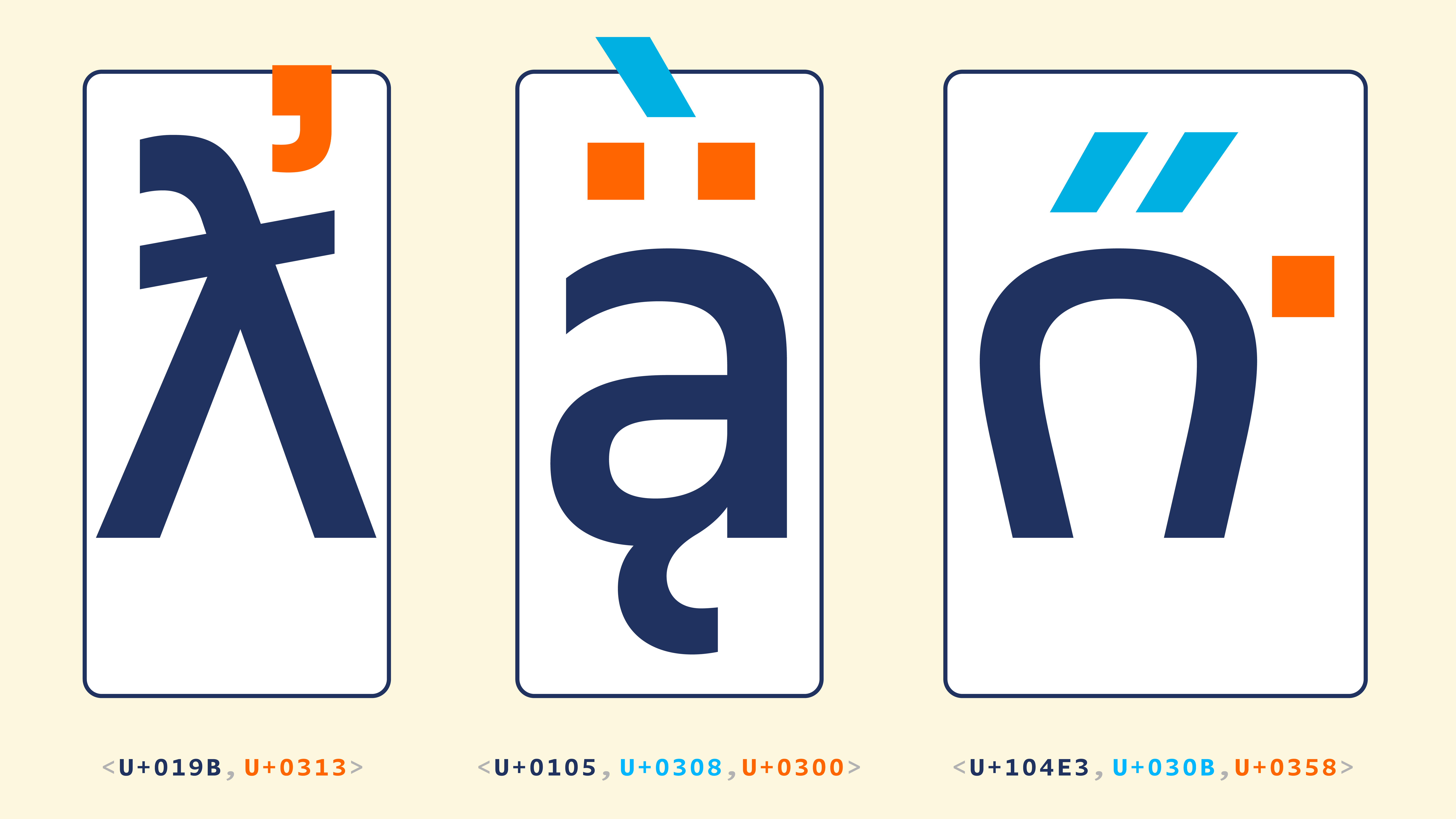
Imagine opening your phone and discovering your language doesn't exist.
Your grandparents speak it. Your community teaches it. Your history lives within it. But when you try to send a text message, write an email, build a website, or create a document, the letters simply aren't there.
For most English speakers, that idea is almost impossible to imagine.
For many Indigenous communities, it has been reality.
This is the challenge Kevin King has devoted his career to solving.
Kevin is a font designer and researcher with Typotheque, an international type design studio based in The Hague, Netherlands. While the company designs typefaces for clients around the world, it also has an extraordinary mission: supporting what it calls digitally disadvantaged languages.
The phrase stopped me in my tracks.
I'd never heard it before.
But once Kevin explained it, I couldn't stop thinking about it.
What Does "Digitally Disadvantaged" Mean?
Most of us never think about the technology behind the letters on our screens.
We simply open our phones, type a message, and assume every letter we need will appear.
For thousands of communities around the world, it isn't that simple.
A language may have a well-established writing system. It may have been taught for generations. Yet if computers, phones, and software don't support the characters needed to write it correctly, that language becomes incredibly difficult to use in modern life.
Children begin texting in English.
Teachers struggle to create learning materials.
Community members invent workarounds.
Every extra barrier pushes people toward the language that is easiest to use.
Usually, that's English.
"It's the path of least resistance," I observed during our conversation.
Kevin nodded.
Exactly.
Why Fonts Matter More Than We Think
Most of us think of fonts as decoration.
Should this invitation be elegant? Should that report use Times New Roman or Arial?
Kevin sees something entirely different.
A font is infrastructure.
Without it, a language cannot fully exist in the digital world.
His work sits at the intersection of design, technology, linguistics, and cultural preservation. He collaborates with Indigenous language keepers, linguists, software developers, and community organizations to ensure languages can be typed, stored, searched, shared, and preserved across modern devices.
The work is astonishingly technical.
It is also deeply human.
Languages Carry More Than Words
As our conversation continued, it became clear that preserving a language isn't simply about preserving vocabulary.
Language carries history. It carries humour. It carries family stories. It carries ways of understanding the land that may have developed over thousands of years.
Kevin described how Indigenous knowledge about forests, rivers, wildlife, and stewardship is embedded within language itself.
When a language disappears, we lose far more than words.
We lose an entire way of seeing the world.
That thought stayed with me.
Not long before speaking with Kevin, I had been talking with another guest about family letters written during the Second World War. Reading those letters connected me to people I had never met and helped me understand where my own family came from.
Languages do the same thing.
They create continuity between generations. They allow elders to speak directly to grandchildren. They preserve identity.
The Bella Bella Story
One of Kevin's favourite projects took him to the Heiltsuk Nation in Bella Bella, on the central coast of British Columbia.
The community had worked for decades to preserve its language.
A standardized writing system had been developed in the 1970s. Teachers were creating learning materials. Language revitalization was gaining momentum.
There was just one problem.
Computers couldn't properly display some of the letters.
It sounds like a small issue.
It wasn't.
Those missing characters meant the language couldn't reliably move into emails, websites, databases, and digital education.
Imagine trying to write English without being allowed to use the letter "E."
Now imagine trying to preserve an entire language that way.
Working alongside community members, Kevin and his colleagues helped prepare a proposal to the Unicode Consortium, the international organization responsible for the global standard that allows computers to understand written languages.
The proposal was accepted.
Missing characters were officially added.
To many people, it might sound like a technical update.
For the Heiltsuk community, it represented something much bigger.
Their language could move confidently into the future.
Building Foundations
Kevin compares this work to building a house.
Before you can decorate, you need a foundation.
Before beautiful typography, before elegant publications, before creative expression, communities need reliable digital tools that simply work.
Once those foundations are in place, something remarkable begins to happen.
Teachers create better educational materials. Young people text each other in their own language. Designers begin exploring typography. Communities move beyond simply preserving language and begin celebrating it.
That transition is where Kevin's background as a designer becomes especially meaningful.
Where Calligraphy Enters the Story
One moment during our conversation made me smile.
Kevin doesn't describe himself as a professional calligrapher.
Yet he credits studying calligraphy as one of the most valuable skills he possesses.
"Calligraphy helps you understand what's happening underneath the letters," he explained.
That understanding becomes essential when designing typefaces for writing systems that have never before existed in digital form.
Every curve. Every connection. Every stroke.
Calligraphy teaches structure before software.
As someone who spends much of her life surrounded by calligraphers, I found that wonderfully reassuring.
The ancient skills still matter.
Perhaps now more than ever.
A Different Kind of Preservation
At the Flourish Emerging Artists & Calligraphers Society, we often talk about preserving the written arts.
That includes calligraphy. Lettering. Manuscript traditions. Historic techniques.
But conversations like this remind us that preserving the written arts also means supporting living languages.
Languages that continue to evolve.
Languages that deserve to thrive in the digital world just as much as English or French.
The work Kevin and his colleagues are doing isn't simply about fonts.
It is about removing barriers so communities can continue telling their own stories in their own voices.
The Future of Writing
When Kevin speaks about his work, he rarely talks about technology first.
He talks about people.
About elders passing knowledge to young people. About teachers creating lessons. About children texting in their own language. About communities reclaiming something that was never truly lost, only made harder to use.
That is the quiet beauty of his work.
Most people will never notice the extra characters appearing on a keyboard.
They'll never think about Unicode or digital encoding.
But somewhere, a child will write a message to a grandparent using the correct letters of their own language.
And because someone cared enough to make those letters exist, an ancient conversation will continue into another generation.
Sometimes preserving culture begins with a single missing character.
Sometimes it begins with a font.
And sometimes, the future of a language depends on whether it can send a text message.