There is a moment almost every artist experiences.
You sit in front of a blank sheet of paper. The brush is in your hand. The paint is ready.
And instead of excitement, you feel hesitation.
What if I ruin it?
What if it isn't good enough?
For many people, that tiny moment becomes the reason they never begin.
Connie Furgason has spent decades helping people move past it.
An accomplished calligrapher, painter, educator, and former organizer of international calligraphy conferences, Connie has built a career around creating beautiful work. Yet when we spoke, she spent surprisingly little time talking about finished pieces.
Instead, she talked about permission.
Permission to experiment. Permission to play. Permission to make mistakes.
And permission to believe that creativity belongs to everyone.
There Is No Such Thing as "Just" a Calligrapher
When I introduced Connie, I almost said she was "just a calligrapher."
I caught myself immediately.
There is no such thing.
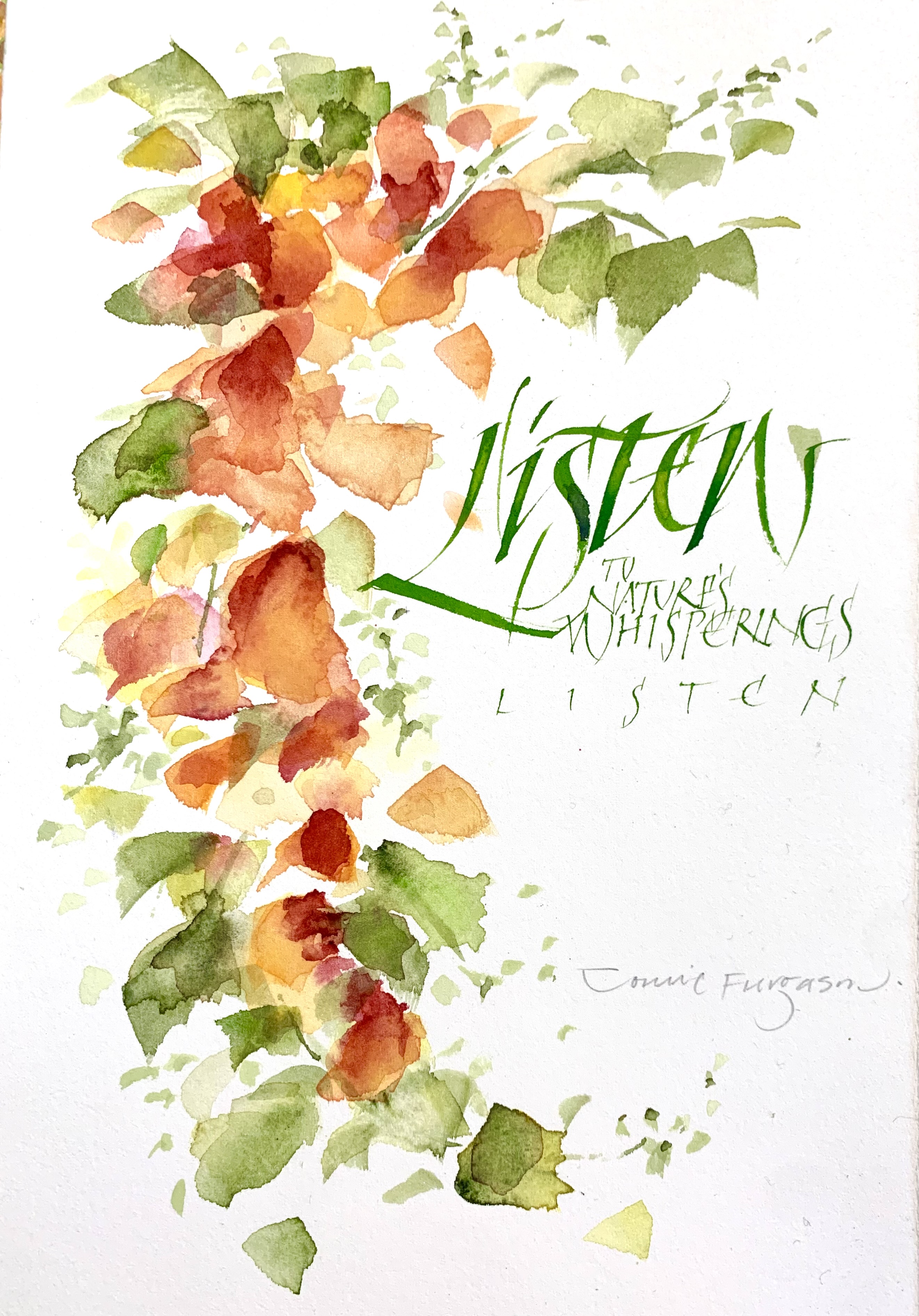
Connie paints sweeping prairie landscapes, expressive florals, abstract mixed-media pieces, and elegant lettering. Her work moves effortlessly between fine art and calligraphy because, to her, they have never really been separate disciplines.
One day she may be preparing paintings for a gallery in Waterton Lakes National Park.
The next she may be creating work for an exhibition inspired by the wildlife and landscapes of southern Alberta.
Then she turns back to lettering.
For Connie, creativity isn't confined to a single medium.
It's one continuous conversation.
Finding Inspiration in Wild Places
Living in southern Alberta means the mountains are never far away.
When Connie needs inspiration, she heads west to Waterton Lakes National Park.
She photographs changing light across the mountains, watches wildflowers emerge in early summer, and fills sketchbooks with ideas that later become paintings.
She smiled as she described the little mountain town.
Unlike many tourist destinations, Waterton has deliberately resisted becoming overdeveloped.
Its quiet streets, dramatic landscapes, and ever-changing weather continue to inspire artists who visit.
Sometimes the best studio has no walls.
Flowers That Welcome Beginners
One of Connie's greatest gifts as a teacher is making difficult things feel possible.
Watching her paint loose watercolour flowers is almost deceptive.
The brush dances. Colour blooms across the paper. Everything looks effortless.
It isn't.
Years of practice sit behind every seemingly simple stroke.
Yet Connie never teaches from a place of intimidation.
Instead, she builds confidence one brushstroke at a time.
"I want people to stop being afraid of painting," she told me.
Rather than chasing perfect realism, students learn to embrace loose forms, flowing colour, and happy surprises.
A flower doesn't need to be botanically perfect.
It needs to feel alive.
Knowing When to Stop
One lesson particularly resonated with me.
Connie compared painting to putting on makeup.
At first, everything looks wonderful. Then you think maybe just a little more. Then a little more.
Before long, you've lost the freshness that made it beautiful in the first place.
Painting works the same way.
Sometimes the hardest artistic decision is knowing when to put the brush down.
She often leaves paintings alone for a while before returning with fresh eyes.
That pause becomes part of the creative process.
Letters and Flowers Belong Together
In Connie's workshops, lettering doesn't compete with painting.
It completes it.
Graceful italic writing drifts between loose watercolour blooms, becoming another design element rather than simply words on a page.
Watching her work, it becomes obvious that lettering and painting speak the same visual language.
Both rely on rhythm. Movement. Contrast. Balance.
Neither exists without the other.
Making Marks Without Fear
Connie's second workshop explores an entirely different side of creativity.
Abstract marks. Layered textures. Threads of handwritten words.
Watercolour. Walnut ink. Gouache. Pencil.
Unexpected combinations become opportunities rather than mistakes.
Students are encouraged to experiment with materials they may never have used before.
Some marks remain visible. Others disappear beneath later layers.
Every decision adds another conversation to the page.
The result feels less like following instructions and more like discovering your own artistic voice.
Every Artist Starts Somewhere
Near the end of our conversation, Connie shared a story about her own first calligraphy class.
She arrived carrying a fountain pen and a few sheets of parchment paper.
She didn't really know what she was doing.
She certainly didn't feel like an artist.
Imagine if someone had looked at that beginner and said, "You're not good enough to be here."
How many beautiful paintings would never have existed?
How many students would never have been encouraged?
How many artists would never have found their confidence?
Fortunately, no one said those words.
Today, Connie makes sure her own students never hear them either.
The Most Important Lesson
Before we finished talking, I asked Connie if she had one final piece of advice for artists.
Her answer was immediate.
"Don't ever tell yourself you're not good enough."
Practice. Experiment. Make mistakes. Play. Leave fear outside the door.
"There is no room for fear in making art."
Those words stayed with me long after we ended our conversation.
At the Flourish Emerging Artists & Calligraphers Society, we believe preserving the written arts isn't only about passing on technical skills.
It's about creating spaces where people feel welcome enough to begin.
Because every accomplished artist was once the person staring nervously at a blank sheet of paper.
Sometimes all they needed was someone like Connie Furgason to hand them a brush and quietly say, "Yes, you can."