There are very few art materials that carry the weight of history quite like lapis lazuli.
Long before artists could order paints with a click of a mouse, creating brilliant blue pigments required something extraordinary. It began high in the mountains of what is now Afghanistan, where miners extracted a stone so intensely blue that civilizations believed it held something almost magical.
That stone was lapis lazuli.
For thousands of years it travelled across continents, finding its way into the treasures of Egypt, the manuscripts of medieval Europe, the paintings of the Renaissance, and eventually into the hands of artists who understood that colour could be every bit as precious as gold.
Today, artists are rediscovering this remarkable material, not simply because of its beauty, but because it reconnects them with centuries of artistic tradition.
A Stone Worth More Than Gold
Lapis lazuli has been treasured for more than six thousand years.
Ancient Egyptians carved it into jewellery, amulets, and ceremonial objects. It was placed in the tombs of pharaohs and worn by royalty as a symbol of wisdom, truth, and the heavens. Even Cleopatra is believed to have used finely ground lapis as part of her cosmetics.
Its rarity made it one of the world's most valuable artistic materials. Before modern pigments existed, obtaining a brilliant blue required an extraordinary amount of labour. Every piece of lapis had to be mined, transported across vast trade routes, and carefully processed by skilled craftspeople.
Artists understood that this was not an ordinary colour. It was something to be used with intention.
The Blue That Changed Art History
Perhaps the greatest legacy of lapis lazuli is the creation of ultramarine.
For centuries, artists painstakingly ground the stone into an incredibly fine pigment that became the most prized blue in European painting. During the Renaissance it was often reserved for the most sacred subjects because it was one of the most expensive colours available.
Many of the paintings we admire in museums today owe their luminous blue skies and flowing robes to this extraordinary stone.
When we look at these masterpieces, we are not simply seeing blue paint. We are looking at thousands of years of geology, trade, craftsmanship, and artistic devotion brought together in a single brushstroke.
Rediscovering Ancient Materials
While modern synthetic pigments have made colour more accessible than ever, many artists are finding themselves drawn back to traditional materials.
During a recent conversation with the Flourish Emerging Artists & Calligraphers Society, artist and paint maker Irfan Qureshi shared his fascination with gemstone pigments and the years he devoted to learning how to transform lapis lazuli into professional-quality artist paints.
His work bridges ancient craftsmanship with modern practice.
Instead of asking artists to spend hours grinding raw stone, he has developed methods that allow painters, illuminators, and calligraphers to experience the depth and brilliance of genuine lapis lazuli while preserving the qualities that have made it legendary for centuries.
For artists working in manuscript illumination, iconography, botanical painting, and fine calligraphy, this offers a rare opportunity to work with a material that has shaped the history of art itself.
Why Traditional Materials Still Matter
At Flourish Emerging Artists & Calligraphers Society, we believe preserving traditional artistic knowledge is just as important as preserving finished works of art.
Every handmade ink, natural pigment, handmade paper, or carefully prepared paint carries with it generations of accumulated knowledge.
When these skills disappear, part of our artistic heritage disappears with them.
Learning how colours were originally created helps us understand not only the finished artwork but also the patience, craftsmanship, and curiosity that produced it.
Learning Through Experience
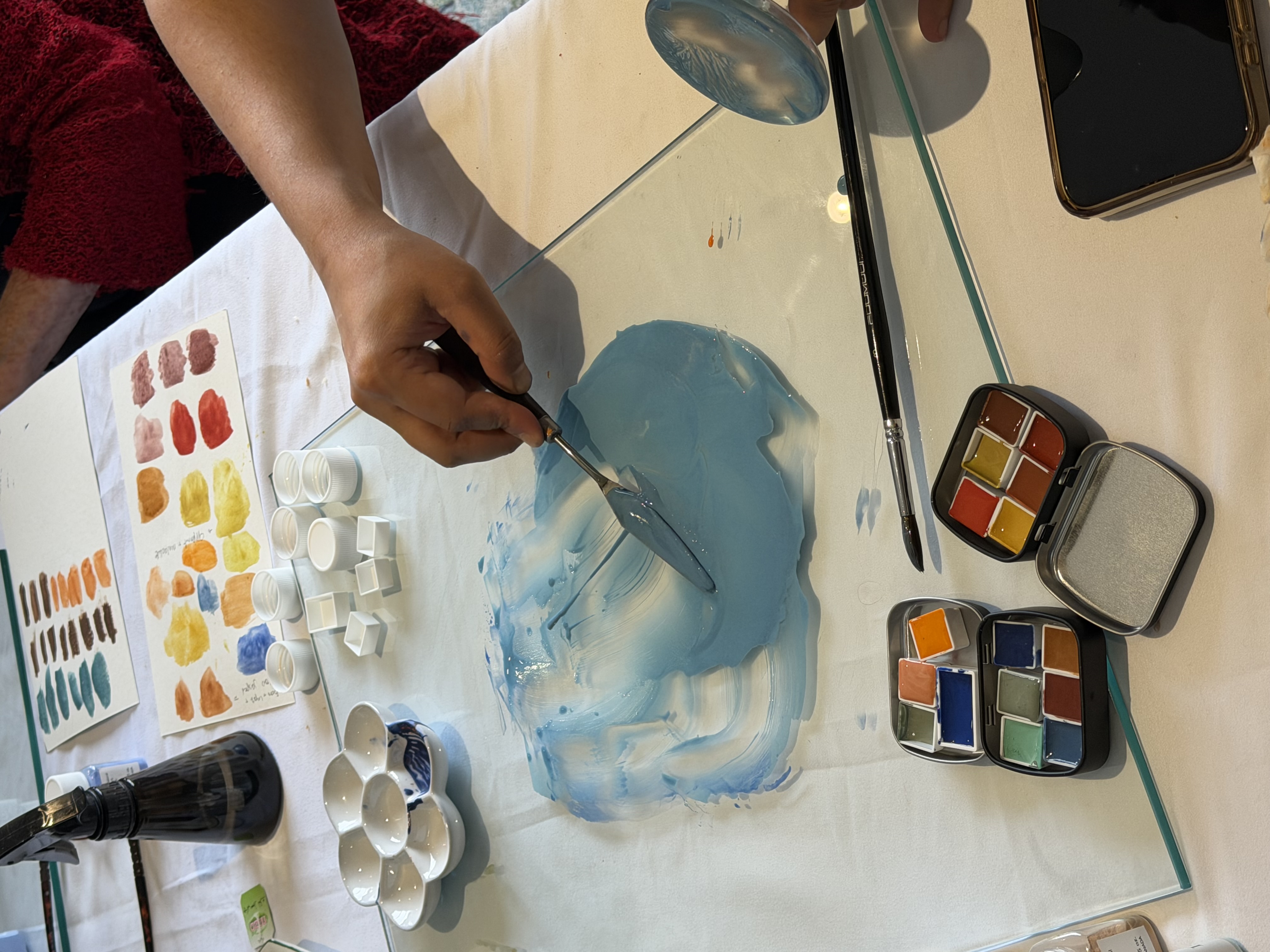
One of the most rewarding ways to understand lapis lazuli is to make paint from it yourself.
Workshops exploring gemstone pigments allow artists to experience the careful process of mixing binders, mulling pigment, and watching an extraordinary colour slowly emerge beneath their hands.
Participants often describe the process as calming and deeply satisfying. There is something profoundly different about painting with a colour you have helped create.
It reminds us that art has never simply been about the finished piece. It is equally about the process, the materials, and the connection between maker and medium.
Preserving the Written Arts
The Flourish Emerging Artists & Calligraphers Society exists to preserve and advance the written arts through education, scholarships, and community.
Conversations with artists such as Irfan Qureshi help document techniques and traditions that might otherwise be lost. By sharing these stories, we hope to inspire emerging artists to explore historic materials while creating new work that will carry these traditions into the future.
Sometimes preserving history begins with something as simple as learning where a remarkable blue came from.
And perhaps, putting it back onto paper.